Upanayanam
Upanayanam in Hyderabad
Arrange a Traditional Sacred Thread Ceremony with Pandit Guidance
Planning Upanayanam in Hyderabad? 99poojas helps families enquire about pandits for traditional Upanayanam ceremonies, discuss the muhurtham and plan the rituals at home, a temple or a function hall.
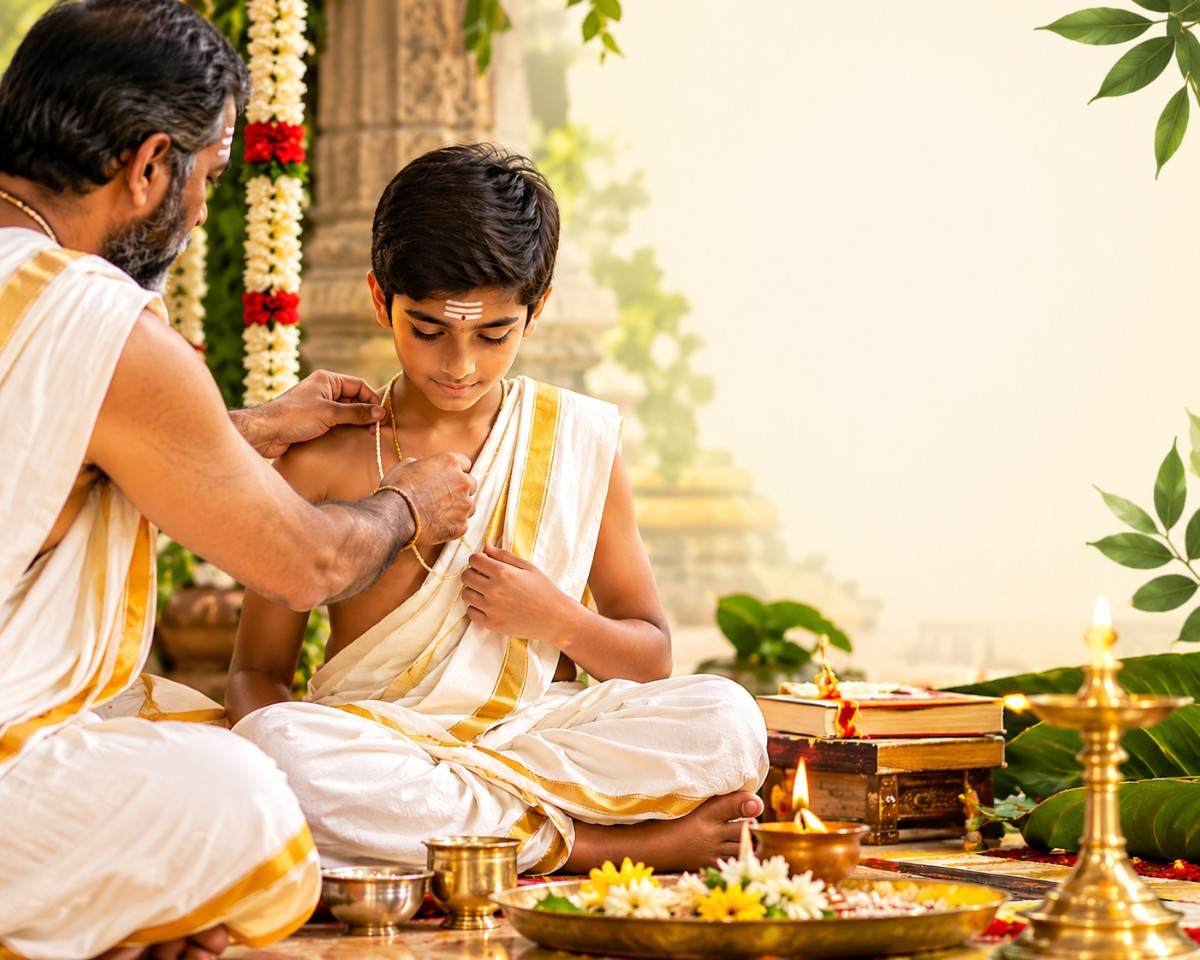
Upanayanam, also called the sacred-thread ceremony or Yagnopaveetham ceremony, is an important Hindu Samskara associated with initiation into Vedic learning and spiritual discipline.
Whether your family follows Telugu Smarta, Vaishnava or another tradition, discussing the ritual requirements, age, ceremony duration and materials beforehand helps you organise the occasion.
Yagnopaveetham Dharanam
Brahmopadesam
Gayatri Mantra
Sandhyavandanam
ॐ
Brahmopadesam
Gayatri Mantra instruction
◯
Yagnopaveetham
Sacred-thread initiation
◷
4–5 hours
A one-day ceremony, around
⌂
Home • Temple • Function hall
Venue options
What Is Upanayanam?
Upanayanam is a Hindu initiation ceremony traditionally associated with the beginning of Vedic study and Brahmacharya. In many communities, it includes Yagnopaveetham Dharanam, Brahmopadesam, Gayatri Mantra instruction and introductory Sandhyavandanam practices. Families in Hyderabad can arrange Upanayanam with a pandit at home, a temple or a function hall, following their community's religious customs.
Key Takeaways
- Upanayanam is an initiation ceremony, not simply a thread-changing ritual.
- The traditional age and eligibility vary across communities.
- Brahmopadesam and Gayatri Mantra instruction are central to many traditions.
- A one-day ceremony may take around 4–5 hours.
- Some families conduct Udakashanti and preparatory rituals on the previous day.
- The required pandits, samagri and venue arrangements depend on the selected ritual.
- After Upanayanam, the initiate is traditionally guided in Sandhyavandanam and related practices.
Cost & Packages
Upanayanam Cost and Packages in Hyderabad
How Much Does Upanayanam Cost in Hyderabad?
The cost of Upanayanam depends on the number of pandits, rituals performed, ceremony duration, materials, location and family tradition.
A one-day ceremony may require fewer arrangements than a two-day event that includes Udakashanti, additional prayers and a larger family gathering.
99Poojas offers two clear packages for Upanayanam in Hyderabad, so you know the price before you book.
Upanayanam packages
Package
What's included
Price
Silver
1 experienced priest. You arrange the pooja materials.
₹10,000
Gold (recommended)
2 experienced priests. All pooja materials (samagri) provided by 99Poojas.
₹12,000
Two-day Upanayanam or with Udakashanti
Preparatory rituals, Udakashanti or arrangements following your family's Sampradaya
Ask for a quote
How payment works
Package
Pay at booking (40%)
Pay after the pooja (60%)
Silver – ₹10,000
₹4,000
₹6,000
Gold – ₹12,000
₹4,800
₹7,200
Pay the 40% advance securely online when you book. The remaining 60% is paid after the pooja is completed. Cancellations made at least 48 hours before the pooja are refundable; cancellations within 48 hours are non-refundable.
What Affects the Final Cost?
The number of priests is an important consideration because Upanayanam can involve several ritual components.
The total may also depend on:
- One-day or two-day arrangements.
- Udakashanti and other preliminary rituals.
- Materials supplied by the family or pandit.
- Homam requirements.
- Venue location and travel expenses.
- Specific family and community customs.
Does Upanayanam Pricing Include Function Hall and Catering?
Not automatically. Function hall rental, catering, decoration, photography and invitation arrangements are separate unless explicitly included in a quotation.
Before booking, request an itemised breakdown of the pandit dakshina, samagri, travel charges and additional services.
What's Included
What's Included in Your Upanayanam Booking?
Understand Your Ceremony Arrangements Before Booking
Upanayanam involves several rituals, and the exact inclusions can differ between families.
A booking may cover the principal initiation ceremony along with selected preliminary prayers.
Before confirming with 99poojas, clarify whether the agreed scope includes:
- Ganapathi Pooja and Sankalpam.
- Punyahavachanam.
- Udakashanti, if requested.
- Nandi or ancestor-related prayers, where prescribed.
- Matru Bhojanam.
- Yagnopaveetham Dharanam.
- Brahmopadesam and Gayatri Mantra instruction.
- Samidadhanam or introductory Sandhyavandanam.
- Bhikshatana and concluding blessings, where followed.
Booking Confirmation Checklist
Ask the following questions before making payment:
- How many pandits will conduct the ceremony?
- Are Udakashanti and preliminary rituals included?
- Will the pandit guide the initiate through Gayatri Mantra instruction?
- Who will arrange the sacred thread, clothing and samagri?
- Is the ceremony planned for one day or two days?
- What are the complete dakshina and travel charges?
- Is a Homam included in the agreed ritual?
- What are the cancellation and rescheduling conditions?
A clear quotation helps the family avoid confusion about the ritual sequence and additional expenses.
Book a Pandit
Book an Upanayanam Pandit in Hyderabad
Find a Pandit for Traditional Upanayanam
A pandit plays an important role in conducting Upanayanam, explaining the ceremonies and guiding the initiate through the prescribed practices.
When enquiring through 99poojas, share your family's tradition, preferred language, date, locality and ceremony requirements.
What Should You Look for in an Upanayanam Pandit?
Select a pandit familiar with the religious tradition followed by your family.
Important considerations include:
- Knowledge of Upanayana Samskara and Brahmopadesam.
- Familiarity with the relevant Smarta, Vaishnava or other community customs.
- Ability to guide Gayatri Mantra instruction and Sandhyavandanam.
- Understanding of the associated Homam and preliminary rituals.
- Ability to communicate in Telugu or another preferred language.
- Availability for the agreed muhurtham.
Can I Request a Telugu-Speaking Pandit?
You can specify Telugu as your preferred language when enquiring with 99poojas.
The Vedic mantras may be recited in Sanskrit, while explanations and family instructions can be requested in Telugu, subject to pandit availability.
Age & Eligibility
Upanayanam Age Requirements and Eligibility
At What Age Should Upanayanam Be Performed?
Traditional texts and community customs prescribe different ages for Upanayanam.
In some Brahmin traditions, the eighth year is traditionally emphasised, while other communities and families follow different ages and interpretations of how the age is counted.
There is no single age rule that applies equally to all Hindu communities.
Can Upanayanam Be Performed After the Traditional Age?
In some traditions, a delayed Upanayanam may be performed during adolescence or adulthood.
The appropriate procedure should be discussed with a pandit familiar with the family's religious lineage.
Can Adults Perform Upanayanam?
Some communities provide for adult Upanayanam, including ceremonies arranged before marriage when the initiation was not performed earlier.
The required rituals and timing may differ from a childhood ceremony.
Who Can Undergo Upanayanam?
Eligibility and practice vary across Hindu communities and religious lineages.
Historically, many traditions primarily conducted Upanayanam for boys in particular communities. Other traditions and contemporary religious institutions may follow different practices, including initiation for girls.
Families should consult an appropriate religious authority for guidance specific to the tradition they wish to follow.
Muhurtham
Upanayanam Muhurtham and Auspicious Date Selection
How Is Upanayanam Muhurtham Selected?
The muhurtham is traditionally selected using the Hindu Panchangam and the family's religious customs.
A pandit may consider:
- The initiate's age.
- Janma Nakshatram.
- Tithi and weekday.
- Relevant Panchangam factors.
- Family tradition and prescribed seasonal preferences.
- The intended ceremony location.
Is a Horoscope Required for Upanayanam?
Many families consult a horoscope or birth details when selecting the muhurtham.
However, the precise requirements depend on the tradition and whether the family is seeking a personalised date.
Which Months Are Considered Suitable?
Some Upanayanam traditions favour particular periods, including dates within Uttarayana.
The appropriate month and muhurtham should be selected according to the relevant Panchangam and religious tradition rather than a universal online date list.
Should the Function Hall Be Booked Before Muhurtham Confirmation?
Confirming the muhurtham first is usually more practical.
Once the date is finalised, arrange the venue, pandits, catering, invitations and other requirements.
Types & Traditions
Types of Upanayanam Ceremonies and Family Traditions
Does Every Family Perform Upanayanam in the Same Way?
No. Upanayanam procedures vary between communities, Vedic Shakhas and religious traditions.
Families may follow:
ॐ
Telugu Smarta Upanayanam
A ceremony conducted according to the family's Smarta and associated Vedic traditions.
✧
Vaishnava Upanayanam
A ceremony following the prescribed customs of the family's Vaishnava Sampradaya.
❋
Other Regional Upanayanam Traditions
Tamil, Kannada, Marathi and other communities may follow distinct ritual sequences and cultural practices.
◷
One-Day Upanayanam
The principal initiation rituals are arranged within a day, with the exact format determined by the pandit.
✦
Two-Day Upanayanam
Preliminary rites such as Udakashanti may be conducted separately before the main initiation ceremony.
Which Ceremony Should You Choose?
Start with the family's established religious tradition rather than selecting a package solely by price or duration.
Procedure & Steps
Upanayanam Procedure and Complete Ritual Steps
How Is Upanayanam Performed?
The exact ritual order varies, but the following steps are common in several Telugu traditions.
1
Ganapathi Pooja
Prayers are offered to Lord Ganesha at the beginning of the ceremony.
2
Punyahavachanam
Sacred-water purification prayers may be performed.
3
Udakashanti
Vedic mantras associated with the prescribed Udakashanti ritual are chanted, where included.
4
Nandi or Ancestor-Related Prayers
Certain traditions conduct preliminary prayers seeking the blessings of ancestors.
5
Matru Bhojanam
The initiate participates in the traditional meal-related observance with the mother, where prescribed.
6
Yagnopaveetham Dharanam
The sacred thread is placed on the initiate according to the ritual instructions.
7
Brahmopadesam
The initiate receives formal Gayatri Mantra instruction from the designated teacher or authorised family participant, according to the tradition.
8
Samidadhanam and Sandhyavandanam
The pandit may guide the initiate through the relevant introductory practices.
9
Bhikshatana
The initiate may symbolically request alms from family members, representing the disciplined student life.
10
Blessings and Conclusion
The ceremony concludes with prescribed prayers and blessings.
Not every family follows every step in precisely this form.
Brahmopadesam
Brahmopadesam and Gayatri Mantra Initiation
What Is Brahmopadesam?
Brahmopadesam is the formal instruction associated with the Gayatri Mantra during Upanayanam.
In many traditions, it is one of the central parts of the ceremony.
Who Teaches the Gayatri Mantra?
The role may be performed by the father, a designated guru or another authorised person according to the family's religious practice.
If the father is unavailable or unable to participate, explain the situation to the pandit beforehand so an appropriate traditional arrangement can be discussed.
Why Is Brahmopadesam Important?
The ceremony marks the beginning of a disciplined religious practice involving mantra recitation, Sandhyavandanam and further learning.
Should the Gayatri Mantra Be Learned Before Upanayanam?
Families may familiarise the initiate with the meaning and responsibilities of the ceremony beforehand.
However, the formal initiation and prescribed instruction should follow the guidance of the family's religious teacher.
Yagnopaveetham Dharanam
Yagnopaveetham Dharanam – Sacred Thread Ceremony
What Is Yagnopaveetham Dharanam?
Yagnopaveetham Dharanam is the ritual wearing of the sacred thread, also called Yajnopavita, Janeu or Poonal in different regional traditions.
The thread is commonly worn over the left shoulder and across the body according to the prescribed method.
What Does the Sacred Thread Symbolise?
Traditional interpretations associate the sacred thread with religious discipline, duties and responsibilities.
Its strands have different symbolic explanations across traditions, including associations with obligations to teachers, ancestors and divine powers.
Is Wearing the Sacred Thread the Entire Upanayanam?
No. Sacred-thread wearing is an important part of Upanayanam, but the full ceremony may also include Brahmopadesam, Homam, vows and instruction in daily practices.
Is Yagnopaveetham Changing the Same as Upanayanam?
No. Upanayanam is an initiation ceremony.
Changing an existing sacred thread is a separate observance that may occur during prescribed religious occasions or according to individual tradition.
Pre-Upanayanam Rituals
Udakashanti, Punyahavachanam and Pre-Upanayanam Rituals
What Is Udakashanti?
Udakashanti is a traditional Vedic ritual involving mantras and the sanctification of water.
Some families arrange it before the principal Upanayanam ceremony.
What Is Punyahavachanam?
Punyahavachanam is a sacred-water purification ceremony performed as part of the preliminary rituals in several Hindu traditions.
Are Udakashanti and Punyahavachanam the Same?
No. They are related sacred-water rituals, but their procedures and ritual purposes differ.
A family may include both according to the prescribed ceremony.
Is Udakashanti Compulsory Before Upanayanam?
Its inclusion and scheduling depend on the family's tradition.
Some families arrange Udakashanti on the preceding day, while others follow a different format.
Can Preliminary Rituals Be Performed on the Same Day?
This depends on the total ritual scope and the pandit's recommendations.
Confirm the sequence and estimated duration before scheduling the ceremony.
One-Day vs Two-Day
Upanayanam Ceremony Duration – One-Day vs Two-Day Arrangements
How Long Does Upanayanam Take?
The principal ceremony commonly takes approximately 4–5 hours in several service arrangements.
Additional preliminary rituals, religious customs and family events can increase the duration.
One-Day vs Two-Day Upanayanam
Consideration
One-Day Ceremony
Two-Day Ceremony
Main Upanayanam
Conducted on the selected day
Conducted on the main day
Preliminary rituals
Scheduled within the agreed format
May be performed the previous day
Udakashanti
If included and feasible
Often arranged separately
Venue arrangements
Usually required for one day
May be required for two days
Pandit schedule
One main ceremony schedule
Multiple ritual sessions
Cost
Depends on ritual scope
May increase with additional sessions
Is a Two-Day Upanayanam More Traditional?
Some families prefer two days because their established ritual sequence includes preliminary ceremonies on the previous day.
A one-day arrangement is not automatically inappropriate, provided it follows the family's accepted religious procedure.
How Much Time Should Guests Reserve?
Ask the pandit for the expected ceremony schedule.
Keep additional time for initial setup, family participation, meals, photographs and concluding blessings.
Samagri & Checklist
Upanayanam Samagri and Preparation Checklist
Upanayanam Pooja Samagri List
The exact samagri depends on the Vedic tradition and chosen ceremony.
Commonly requested items include:
Pooja material
Purpose
Yagnopaveetham / sacred thread
Sacred-thread initiation
Dhoti and angavastram
Traditional clothing
Kalasham
Ritual worship
Coconut and mango leaves
Traditional offerings
Turmeric and kumkum
Pooja materials
Akshatalu
Ritual offerings and blessings
Flowers and garlands
Worship
Fruits and Naivedyam
Food offerings
Betel leaves and nuts
Traditional offerings
Homa Kundam
Sacred-fire ritual, where prescribed
Ghee and Homa Dravyam
Fire offerings
Samidhalu
Sacred-fire materials
Mekhala, danda and other traditional items
As prescribed by the Vedic tradition
Family Preparation Checklist
- Confirm the muhurtham and ceremony schedule.
- Ask for the final samagri list.
- Arrange the sacred thread and clothing as instructed.
- Confirm the number of pandits.
- Keep the initiate's birth details and Gotra ready, if applicable.
- Prepare suitable seating and a safe ritual area.
- Coordinate meals and guest arrangements.
- Confirm the venue's rules for Homam.
- Ask how the initiate will be taught post-ceremony practices.
Should the Family Purchase Every Item in Advance?
No. Specialised materials such as Mekhala, danda and other ritual items may differ by tradition.
Purchase them only after receiving the pandit's confirmed list.
Venue Options
Upanayanam at Home vs Function Hall vs Temple in Hyderabad
Where Can Upanayanam Be Performed?
Upanayanam may be performed at home, in a suitable function hall or at a temple where the ceremony is permitted.
The venue should accommodate the ritual setup, pandits, initiate and participating family members.
Venue Comparison
Venue
Suitable for
What to confirm
Home
Smaller family ceremonies
Space, ventilation and Homam safety
Function hall
Larger gatherings
Muhurtham access, fire permissions and facilities
Temple
Families preferring a temple setting
Temple rules, booking, ritual availability and guest limits
Can Upanayanam Be Performed in an Apartment?
It may be possible if sufficient space is available and the building permits the ritual.
When a sacred fire is involved, verify the building's rules and arrange a suitably safe location.
Is a Function Hall Necessary?
No. A function hall is not compulsory for every Upanayanam.
Families may choose a venue based on guest numbers, religious requirements, convenience and budget.
Smarta vs Vaishnava
Upanayanam Traditions – Telugu Smarta vs Vaishnava vs Other Customs
Why Do Upanayanam Rituals Differ Across Families?
Upanayanam follows a family's particular religious lineage, Vedic Shakha and community customs.
Differences may concern the mantras, preliminary rituals, clothing, ceremony sequence and religious instruction.
ॐ
Telugu Smarta Traditions
Smarta families may follow procedures prescribed by their Vedic Shakha and household tradition.
✧
Vaishnava Traditions
Vaishnava families may follow specific ritual practices associated with their Sampradaya.
❋
Other Community Traditions
Other Hindu communities and religious institutions may use different procedures or forms of initiation.
How Should Families Choose a Pandit?
Tell the pandit your family's tradition before booking.
If you are unsure, consult family elders or an established religious teacher to identify the relevant customs.
After Upanayanam
Responsibilities and Daily Practices After Upanayanam
What Happens After Upanayanam?
Upanayanam traditionally marks the beginning of ongoing religious responsibilities rather than the completion of a single ceremony.
The initiate may be guided to follow practices appropriate to the family's religious tradition.
☀
Sandhyavandanam
Sandhyavandanam is a daily prayer practice followed in many traditions after Upanayanam.
The pandit or teacher should explain the prescribed procedure and help the initiate learn it correctly.
ॐ
Gayatri Mantra Practice
The initiate is traditionally instructed in regular Gayatri Mantra recitation according to the applicable religious discipline.
◯
Caring for the Sacred Thread
The family should ask the pandit about the proper manner of wearing and caring for the Yagnopaveetham, including relevant replacement observances.
✦
Continuing Religious Education
Parents can arrange further instruction from a knowledgeable teacher to support the initiate in understanding the prayers, meanings and responsibilities associated with Upanayanam.
Practical Recommendation: Request a post-ceremony learning plan from the pandit, including a Sandhyavandanam demonstration and guidance on where the initiate can obtain continued instruction.
Why 99poojas
Why Choose 99poojas for Upanayanam?
Plan Your Upanayanam with Clear Ceremony Requirements
99poojas provides a point of contact for families enquiring about traditional Upanayanam arrangements in Hyderabad.
When submitting an enquiry, discuss:
✧
Pandit and Tradition Preferences
Explain the family's Sampradaya and preferred language.
◷
Muhurtham Planning
Share the selected date or request guidance on choosing a suitable day.
ॐ
Ritual Requirements
Confirm Brahmopadesam, Udakashanti, Punyahavachanam and other planned ceremonies.
✿
Samagri Arrangements
Clarify which materials the family must provide.
▦
One-Day or Two-Day Schedule
Request a complete ritual timetable.
₹
Pricing and Booking Conditions
Confirm the pandit dakshina, additional charges and cancellation terms.
These discussions can help the family prepare for the ceremony with fewer last-minute uncertainties.
How to Book
How to Book Upanayanam Pooja with 99poojas
Upanayanam Pandit Booking Process
1
Submit an Enquiry
Share your name, contact number and Hyderabad locality.
2
Explain the Family Tradition
Mention Smarta, Vaishnava or another relevant tradition, if known.
3
Share the Initiate's Details
Provide the age and any relevant information required for muhurtham guidance.
4
Choose the Ceremony Format
Discuss one-day, two-day or a customised traditional arrangement.
5
Review the Ritual Requirements
Confirm pandit count, samagri, Udakashanti, Brahmopadesam and the ceremony schedule.
6
Finalise the Quotation
Review the complete cost and booking terms.
7
Prepare the Venue
Arrange the required materials, suitable seating and any permitted sacred-fire setup.
Gallery & Reviews
Upanayanam Ceremony Gallery and Family Reviews
Upanayanam Ceremony Gallery
A useful gallery should show the actual stages of the ceremony and help parents understand the arrangements.
Recommended photographs include:
Upanayanam Ceremony GalleryExplore traditional Upanayanam ceremony arrangements, Yagnopaveetham Dharanam, Brahmopadesam and sacred Vedic rituals performed by Telugu pandits in Hyderabad.
Reviews from Hyderabad Families
Authentic reviews can help families understand the booking experience.
Useful testimonials may discuss pandit communication, understanding of family traditions, punctuality, guidance during Brahmopadesam and clarity about samagri.
Do not publish invented testimonials, reviews or star ratings.
Service Areas
Upanayanam Service Areas in Hyderabad
Upanayanam Pandit Enquiries Across Hyderabad
Families can enquire through 99poojas about Upanayanam arrangements in Hyderabad and Secunderabad.
We accept Upanayanam booking enquiries across the following areas in Hyderabad and Secunderabad:
- Kukatpally
- KPHB
- Miyapur
- Kondapur
- Madhapur
- Gachibowli
- Manikonda
- Nizampet
- Bachupally
- Kompally
- Secunderabad
- Uppal
- Nagole
- LB Nagar
- Dilsukhnagar
- Ameerpet
- Mehdipatnam
- Attapur
- Tellapur
- Banjara Hills
- Jubilee Hills
- Himayatnagar
Pandit availability, applicable travel charges and ceremony arrangements should be confirmed for each locality.
Can I Arrange Upanayanam in Gachibowli or Kukatpally?
You can submit an enquiry for either locality. Confirmation depends on the selected date, pandit availability and family requirements.
FAQs
Frequently Asked Questions
1. What Is Upanayanam?
Upanayanam is a Hindu initiation ceremony traditionally associated with the sacred thread, Vedic learning, Gayatri Mantra instruction and Brahmacharya.
2. How Much Does Upanayanam Cost in Hyderabad?
Upanayanam in Hyderabad costs ₹10,000 with the Silver package (one priest; your family arranges the samagri) or ₹12,000 with the Gold package (two priests, with all samagri provided by 99Poojas). You pay a 40% advance when booking and the remaining 60% after the pooja.
The cost depends on the number of pandits, ceremony duration, materials, rituals and venue. Contact 99poojas for a quotation.
3. At What Age Should Upanayanam Be Performed?
Traditional ages differ across communities. Some Brahmin traditions emphasise the eighth year, while other practices follow different age guidelines.
4. Can Upanayanam Be Performed for Adults?
Yes, some traditions permit delayed Upanayanam for adults, including before marriage. The ritual should follow the relevant religious guidance.
5. Can Upanayanam Be Performed at Home?
Yes. Upanayanam may be arranged at home when sufficient space and suitable facilities are available.
6. How Long Does Upanayanam Take?
A one-day ceremony commonly takes approximately 4–5 hours. Some families conduct additional rituals over two days.
7. Is Brahmopadesam Part of Upanayanam?
Yes. Brahmopadesam is a central part of Upanayanam in many traditions and involves formal Gayatri Mantra instruction.
8. What Is Yagnopaveetham Dharanam?
It is the ritual wearing of the sacred thread during Upanayanam.
9. Is Yagnopaveetham Changing the Same as Upanayanam?
No. Upanayanam is an initiation ceremony, while changing an existing sacred thread is a separate observance.
10. What Is Udakashanti?
Udakashanti is a Vedic ritual involving sacred-water worship and prescribed mantras. It may be arranged before Upanayanam.
11. Is Punyahavachanam Included in Upanayanam?
It is commonly performed as a preliminary ritual in several traditions, but its inclusion should be confirmed with the pandit.
12. How Many Pandits Are Needed?
The number depends on the ritual format. Some elaborate Upanayanam ceremonies involve two or more pandits.
13. What Materials Are Needed for Upanayanam?
Common items include Yagnopaveetham, dhoti, angavastram, Kalasham, flowers, fruits, Homam materials and items specific to the family's tradition.
14. Can Upanayanam Be Completed in One Day?
Yes. Many families arrange the principal ceremony in one day, subject to their religious requirements.
15. Is a Two-Day Upanayanam Necessary?
Not always. Some traditions include preliminary rituals on a separate day, while others use a one-day format.
16. What Is Bhikshatana?
Bhikshatana is a symbolic practice in which the initiate requests alms, representing the traditional life of a student.
17. What Is Matru Bhojanam?
Matru Bhojanam is a traditional meal-related observance involving the initiate and mother, included in certain Upanayanam traditions.
18. Can I Request a Telugu-Speaking Upanayanam Pandit?
You can request Telugu as the preferred language when contacting 99poojas. Availability should be confirmed.
19. Is a Horoscope Required for Upanayanam?
Birth details or a horoscope may be requested for personalised muhurtham selection, depending on the tradition.
20. Can Upanayanam Be Performed Before Marriage?
Some communities arrange delayed Upanayanam before marriage when it was not conducted earlier.
21. Can Upanayanam Be Performed in a Function Hall?
Yes. A suitable function hall can accommodate Upanayanam, provided its facilities and rules meet the ceremony's requirements.
22. What Should the Initiate Do After Upanayanam?
In many traditions, the initiate begins or continues practices such as Sandhyavandanam, Gayatri Mantra recitation and further religious learning.
23. Can Girls Undergo Upanayanam?
Practices differ across Hindu communities and religious institutions. Some traditions conduct Upanayanam for girls, while others have different eligibility customs.
24. Are Catering and Decorations Included?
Not automatically. These should be treated as separate event arrangements unless included in the agreed quotation.
25. How Early Should Upanayanam Be Booked?
Enquiring several weeks in advance is practical, especially for muhurtham dates, multi-pandit ceremonies and function hall arrangements.
26. How Can I Book Upanayanam with 99poojas?
Share your preferred date, Hyderabad locality, family tradition and contact details. Confirm the pandits, cost, rituals and materials before booking.
Enquiry Form
Book Your Upanayanam in Hyderabad
Arrange a Traditional Upanayanam Ceremony with 99poojas
Upanayanam marks an important stage in religious learning and spiritual responsibility.
Whether you are planning the ceremony for a child or arranging a delayed Upanayanam according to family tradition, understanding the rituals and confirming the arrangements helps make the occasion meaningful.
99poojas can receive your enquiry for pandit requirements, muhurtham guidance, materials and ceremony planning in Hyderabad.
Enquire About Upanayanam with 99poojas
Conclusion
Upanayanam is a significant Hindu initiation ceremony associated with sacred-thread wearing, Gayatri Mantra instruction and the beginning of disciplined religious practice.
The appropriate age, muhurtham, ritual sequence and responsibilities vary according to family and community traditions.
For Upanayanam in Hyderabad, contact 99poojas to enquire about pandit availability, ceremony options, materials, duration and cost.