Book a Telugu Pandit
Samuhika Satyanarayana Vratam in Hyderabad
Planning a Samuhika Satyanarayana Vratam in Hyderabad for your apartment community, temple committee, residential association or family group?
99Poojas helps you enquire about Telugu pandits and the arrangements needed for a collective Sri Satyanarayana Swamy Vratam.
A group ceremony requires more planning than an individual household Vratam. Organisers must consider the number of participating families, sankalpam details, pooja materials, priest requirements, venue arrangements, prasadam and the overall schedule.
Share your requirements with 99Poojas to discuss suitable arrangements, priest availability and applicable charges before confirming your event.
❋
Community ceremonies
Apartments, temples, family groups
ॐ
Telugu pandits
Language preference on request
📜
Vratam Katha
Commonly in five chapters
₹
Itemized quotation
Before confirming your event
At a Glance
Samuhika Satyanarayana Vratam in Hyderabad: At a Glance
Quick Answer
Samuhika Satyanarayana Vratam is a collective Hindu worship ceremony in which multiple families or devotees participate in prayers dedicated to Lord Satyanarayana, a form of Lord Vishnu. In Hyderabad, communities may organise the Vratam in temples, residential clubhouses or other suitable venues. The ceremony generally includes sankalpam, kalasha worship, Satyanarayana Vratam Katha, offerings and harathi. Priest arrangements, participation rules, materials and charges depend on the organiser and the selected procedure.
Ceremony Detail
Information
Pooja name
Samuhika Satyanarayana Vratam
Alternative name
Samoohika Satyanarayana Vratham
Deity
Lord Sri Satyanarayana Swamy, a form of Lord Vishnu
Ceremony type
Collective or group devotional Vratam
Suitable organisers
Community associations, temples, family groups and religious organisations
Common venues
Apartment clubhouses, community halls, temples or other suitable spaces
Main rituals
Sankalpam, kalasha worship, Satyanarayana Katha, naivedyam and harathi
Language preference
Telugu can be requested
Number of priests
Depends on participant count and ritual arrangements
Pooja duration
Varies according to the event schedule and group size
Materials
Shared altar items and applicable individual-family items
Charges
Based on the agreed ceremony and event arrangements
Location
Hyderabad, Telangana
Enquiry
Contact 99Poojas to discuss priest and event requirements
Key Takeaways
- Samuhika Vratam involves multiple families participating in a collective ceremony.
- The organiser usually coordinates the venue, registration and common arrangements.
- Participating families may need separate pooja materials, depending on the ritual format.
- Sankalpam procedures and gothram requirements should be confirmed with the priest.
- Priest charges and individual participation fees are not necessarily the same.
- A privately organised group Vratam is different from registering for an existing temple event.
Enquiry Form
Enquire About Group Satyanarayana Vratam Arrangements
Planning a community Satyanarayana Pooja? Share the details of your event to begin an enquiry.
Recommended Enquiry Form
Booking Note: An enquiry does not confirm a pandit, venue, public participation slot or event booking. These details must be agreed upon before confirmation.
What Is Samuhika Vratam
What Is Samuhika Satyanarayana Vratam?
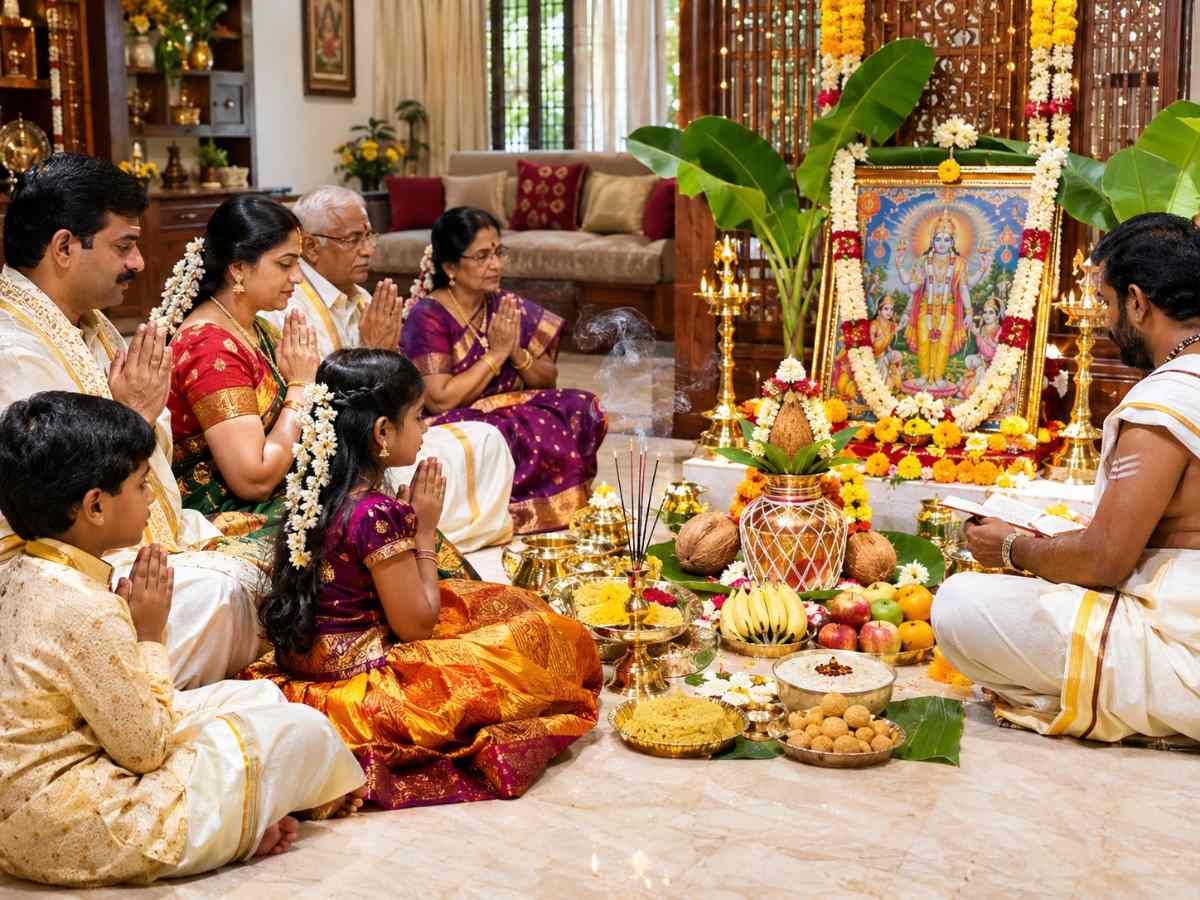
Samuhika Satyanarayana Vratam is a collective form of Sri Satyanarayana Swamy worship in which several families or devotees participate together.
The word Samuhika means collective or group-based. Unlike a private household Vratam, a Samuhika ceremony brings multiple participants into a shared religious gathering.
The worship is dedicated to Lord Satyanarayana, a form of Lord Vishnu associated in Hindu tradition with truth, devotion and righteous living.
The ceremony commonly includes traditional prayers, offerings, the narration of Satyanarayana Vrata Katha and the sharing of prasadam.
Religious Significance of the Vratam
Devotees traditionally observe Satyanarayana Vratam to express gratitude, seek divine blessings and pray for the welfare of their families.
Performing the ceremony collectively also provides an opportunity for neighbours, relatives and community members to participate in devotional worship together.
The spiritual benefits associated with the Vratam are matters of religious faith and tradition rather than guarantees of particular outcomes.
Why Is It Performed as a Group?
A Samuhika Vratam may be organised when several families wish to observe the ceremony on the same occasion.
A common altar, priest-led prayers and group Katha can make collective participation practical.
Depending on the event format, families may share some arrangements while maintaining their own sankalpam details and individual offerings.
The exact participation procedure should be confirmed by the conducting priest.
Samuhika Vratam and Individual Vratam
The central devotion and many ritual elements are similar, but their organisation differs.
An individual Vratam focuses on one household, while a Samuhika Vratam involves multiple participants, a common schedule and additional coordination.
Organise or Participate
Organise or Participate in Samuhika Satyanarayana Vratam
There are two important ways people may wish to take part in a group Vratam.
Understanding the difference helps you choose the correct enquiry process.
❋
Organise a Private Group Vratam
You may wish to organise a collective Vratam for residents of an apartment complex, members of a community association, relatives or a religious group.
The organiser is generally responsible for coordinating the venue, participants, schedule and common arrangements.
If your community wishes to organise a new event, enquire about priest availability and the ceremony requirements.
✧
Join a Scheduled Samuhika Vratam
Some temples and religious organisations conduct group Satyanarayana Vratams on announced dates.
Participants may be required to register in advance, provide customary sankalpam information and bring specified materials.
For example, Hyderabad's Ashtalakshmi Devalayam has published a Samuhika Satyanarayana Vratham listing that requests participant details and refers devotees to a prescribed samagri list.
Important: This example does not mean 99Poojas operates the temple event or currently offers public participation slots. Public event registration should be confirmed directly with the relevant organiser.
Which Option Should You Choose?
Your Requirement
Suitable Enquiry
Our apartment wants to organise a Vratam
Private group ceremony
Our association has selected a community hall
Private group ceremony
Our relatives want to perform a Vratam together
Family group ceremony
I want to join an already announced temple Vratam
Public event registration with the organiser
I want only my family to perform a Vratam
Individual Satyanarayana Vratham
Charges
Samuhika Satyanarayana Vratam Charges in Hyderabad
The cost of organising a Samuhika Satyanarayana Vratam depends on the scale and format of the event.
An event involving a few families may require different priest, material, seating and coordination arrangements from a larger residential community gathering.
Before requesting a quotation, establish whether you need only pandit services or assistance with additional event arrangements.
What Affects the Cost of a Group Vratam?
Cost Factor
What to Confirm
Priest dakshina
Charges for the agreed ritual services
Number of priests
Whether additional priests are required
Common pooja materials
Items used for the shared altar
Individual family materials
Items required for each participating family
Deity and altar setup
Decoration and ceremonial arrangements
Prasadam
Ingredients, preparation and distribution responsibility
Venue
Hall rental, seating or facility charges
Sound equipment
Microphone or speakers for larger gatherings
Travel
Any applicable priest transportation charges
Additional requirements
Optional arrangements agreed with the organiser
Organiser Charges vs Per-Family Participation Fees
These are two different pricing approaches.
Organiser-funded ceremony
The organising association or group pays the agreed event expenses, subject to its internal arrangements.
Participant-funded ceremony
Families contribute a specified amount towards shared costs or pay a registration fee to the event organiser.
Mixed arrangement
The organiser covers certain expenses while participating families arrange or contribute towards specific items.
99Poojas should communicate which costs are included in its quotation. Any participation fee collected by an independent organiser should be explained separately.
How to Request a Group Vratam Quote
Provide the following:
- Number of participating families.
- Approximate number of attendees.
- Selected or preferred date.
- Venue location.
- Priest language preference.
- Whether common samagri is already available.
- Whether individual family kits are required.
- Any requested additional arrangements.
Request an itemized quotation that separates priest dakshina, materials, travel and optional expenses.
Request Samuhika Satyanarayana Vratam ChargesArrangements & Inclusions
Group Vratam Arrangements and What Is Included
A collective Vratam involves shared responsibilities between the priest, event organiser, participants and any additional service providers.
Before finalising an event, confirm each responsibility in writing.
Priest Services
The priest's role generally includes conducting the agreed prayers, guiding participants through applicable ritual steps, performing the worship and leading the Katha.
For a larger group, the organiser should confirm whether a single priest can adequately conduct the agreed procedure or whether assistants are needed.
Common Altar and Pooja Setup
A shared worship area may include:
- Lord Satyanarayana Swamy's image or idol
- Pooja peetam and altar cloth
- Kalasham and supporting items
- Flowers and garlands
- Lamps and incense
- Common ritual vessels
- Naivedyam and offerings
The exact arrangement depends on the priest's instructions.
Individual Family Arrangements
Some group Vratams provide separate pooja places for participating families.
Depending on the tradition and event format, each family may need a pooja plate, flowers, fruits, coconut, akshata or other materials.
Other group ceremonies may use a predominantly shared altar with collective participation.
Do not assume every family must purchase an identical full kit.
Prasadam and Optional Arrangements
Prasadam preparation may be handled by the organiser, participating families or an agreed provider.
If the event includes meals, additional decorations, sound equipment or seating arrangements, these should be specified separately.
Responsibility Checklist
Arrangement
Responsibility to Confirm
Pandit services
Priest or booking coordinator
Shared altar
Organiser or agreed provider
Family pooja kits
Organiser, families or agreed provider
Participant registration
Event organiser
Venue booking
Event organiser
Prasadam
Organiser, families or agreed provider
Drinking water and sanitation
Venue or organiser
Audio equipment
Venue or organiser
Booking charges
As stated in the agreed quotation
Who Can Organise
Who Can Organise Samuhika Satyanarayana Vratam?
A collective Satyanarayana Vratam can be considered by any community or group able to arrange a suitable venue and follow the agreed religious procedure.
🏢
Apartment and Gated Community Associations
Residential associations may organise a collective Vratam for interested residents.
A clubhouse or common hall can provide space for a shared altar and participating families.
Before proceeding, the association should obtain any necessary permissions and agree on the event budget.
ॐ
Temples and Religious Groups
Temple committees and religious organisations may conduct Samuhika Vratams as part of their devotional programmes.
Such events may have their own registration conditions, participation fees and material requirements.
Priest and venue arrangements should follow the institution's rules.
⌂
Families and Community Gatherings
Relatives or community members may choose to organise one ceremony together rather than conduct several separate household Vratams.
For a private gathering, establish the number of families, the preferred procedure and the available venue before arranging the priest.
How It Is Performed
How Is Samuhika Satyanarayana Vratam Performed?
A Samuhika Satyanarayana Vratam generally includes traditional prayers, sankalpam, worship of Lord Satyanarayana, the narration of the Vrata Katha, offerings and harathi.
The procedure is similar in devotional purpose to an individual Satyanarayana Vratam, but coordinating multiple participants may require additional instructions.
The exact sequence depends on the conducting priest and the customary tradition followed.
1
1. Ganapathi Pooja and Preliminary Prayers
The ceremony may begin with prayers to Lord Ganesha and other preliminary worship as prescribed.
2
2. Sankalpam for Participating Families
Sankalpam expresses the intention to perform the Vratam.
3
3. Kalasha Sthapana and Satyanarayana Worship
A kalasham is prepared according to the ritual instructions, followed by worship of Lord Satyanarayana.
4
4. Satyanarayana Vratam Katha
The Satyanarayana Vrata Katha is commonly narrated in five chapters.
5
5. Naivedyam and Prasadam
The prescribed food offerings are presented during the ceremony.
6
6. Mangala Harathi and Conclusion
The Vratam generally concludes with harathi, prayers, blessings and prasadam distribution.
How Group Participation Differs
A large gathering may require scheduled registration, shared announcements, assigned seating and coordination during sankalpam.
These organisational steps support the ceremony but are not themselves compulsory religious rituals.
Sankalpam & Registration
Group Sankalpam, Family Registration and Participation
Registration is one of the main practical differences between a group Vratam and a private household ceremony.
The organiser should agree on the information needed before asking families to register.
How Should Families Register?
A simple registration process may collect:
- Main contact person's name
- Number of participating family members
- Contact number
- Any venue-specific requirements
- Customary sankalpam details, when requested by the priest
- Confirmation of required materials
- Registration or contribution status, if applicable
Collect only information genuinely needed for the event, explain its purpose and handle personal details appropriately.
Are Gotram Details Required?
Some organisers and priests request gotram information for sankalpam.
For example, Hyderabad's Ashtalakshmi Devalayam publishes a group Satyanarayana Vratam registration form containing a gothram field.
However, the exact requirements should come from the conducting priest. Not every event necessarily follows an identical registration or sankalpam format.
Does Every Family Need a Separate Sankalpam?
Not necessarily in the same form.
A priest may guide individual families through their sankalpam details or follow a collective format suitable for the ceremony.
Ask how participants should identify their family details and whether separate participation time is needed.
Participation Instructions for Families
Before the ceremony, participants should receive information about:
- Reporting time
- Venue entrance and seating
- Required pooja materials
- Dress expectations, if specified by the organiser
- Sankalpam procedure
- Prasadam arrangements
- Expected completion time
Clear instructions help avoid confusion during a shared ceremony.
Samagri List
Samuhika Satyanarayana Vratam Pooja Samagri List
The materials required for a group Satyanarayana Vratam can be divided into common altar items and items arranged for individual families.
This is a preliminary planning checklist. The final materials and quantities must be confirmed by the conducting priest.
Common Pooja Materials
Category
Suggested Items to Discuss
Main altar
Lord Satyanarayana image or idol, peetam and cloth
Kalasham
Kalasham, coconut, mango leaves and water
Traditional offerings
Turmeric, kumkum, sandalwood and akshata
Flowers
Loose flowers, garlands and suitable leaves
Fruits
Bananas, coconuts and other fruits
Lamps
Brass lamps, wicks, ghee or oil
Incense
Agarbatti and other prescribed items
Ritual vessels
Plates, bowls, spoons and water vessels
Naivedyam
Ingredients for the agreed prasadam
Additional items
Materials prescribed by the priest
Materials for Each Family
Depending on the chosen procedure, participating families may need:
- Individual pooja plate
- Flowers and akshata
- Coconut and fruits
- Turmeric and kumkum
- Betel leaves and nuts, if prescribed
- Small vessels or lamps, if required
- Other items specified by the priest
Who Arranges the Materials?
The organiser should clarify whether common materials and family kits are supplied, purchased separately or brought by the participants.
A materials list should state:
- Item name
- Quantity
- Common or per-family requirement
- Person responsible
- Any permissible substitute
Date & Duration
Date, Muhurtham and Duration of Group Satyanarayana Vratam
Which Dates Are Suitable?
Sri Satyanarayana Vratam is commonly associated with Pournami and other meaningful devotional occasions.
Karthika Masam is also a period when temples and communities may organise Satyanarayana worship.
However, families and organisers may choose other suitable dates according to their traditions and priestly guidance.
How Is the Muhurtham Selected?
The date and time should be discussed with the priest conducting the group Vratam.
Consider the relevant Panchangam guidance, the availability of participants, venue access and the time required for the full ceremony.
Avoid announcing a specific muhurtham until it has been confirmed.
How Long Does Group Satyanarayana Vratam Take?
An individual Satyanarayana Vratam is often planned for a few hours.
A Samuhika Vratam may take longer because of registration, family participation, group instructions and prasadam distribution.
There is no universal group-ceremony duration. Ask the priest and organiser to prepare an estimated event schedule.
Suggested Event Schedule Format
Stage
Planning Requirement
Participant arrival
Registration and seating
Preliminary preparations
Altar and priest readiness
Main ceremony
Sankalpam, worship and Katha
Closing rituals
Naivedyam and harathi
Prasadam
Distribution and orderly departure
Allocate sufficient time without publishing arbitrary duration commitments.
Venue & Seating
Venue and Seating Arrangements for a Group Vratam
A suitable venue helps participants follow the ceremony comfortably and allows the priest to conduct the prescribed rituals.
The required space depends on the expected number of families and the chosen altar arrangement.
Space for Participating Families
Before finalising the venue, decide:
- Whether families will sit together or in designated groups.
- Whether individual pooja peetams are required.
- Whether all participants can clearly see the main altar.
- Whether there is accessible movement space.
- Whether suitable arrangements exist for elderly participants and children.
Seating and Pooja Peetam
If participants require individual pooja spaces, their arrangement should be discussed with the priest.
The main altar should remain accessible to the conducting priest throughout the ceremony.
Avoid overcrowding the altar area.
Audio, Lighting and Safety
For larger gatherings, a microphone and speaker system can help participants hear the Katha and instructions.
Check venue lighting, ventilation, drinking water, sanitation and access routes.
If the agreed procedure includes any sacred fire, discuss venue permissions and appropriate fire-safety arrangements in advance. A separate homam should not be assumed to form part of every Satyanarayana Vratam.
Organiser's Practical Preparation Checklist
- Venue booking confirmed
- Expected number of families recorded
- Priest requirements discussed
- Common altar space allocated
- Participant seating planned
- Materials checklist distributed
- Audio requirements assessed
- Prasadam responsibilities assigned
- Registration and arrival instructions shared
- Event expenses and payment responsibilities clarified
Practical Planning Insight: Separate the Ritual Plan From the Event Plan
For a group Vratam, prepare two short documents.
ॐ
Ritual plan
Approved procedure, priest count, sankalpam method, required materials, offerings and estimated ritual sequence.
✦
Event plan
Registration, seating, venue access, audio, volunteers, prasadam, payment responsibilities and participant communication.
Separating these plans helps identify whether a pending task belongs to the priest, the organiser or a service provider.
This is practical event-planning guidance. The ritual plan should be reviewed by the pandit who will conduct the ceremony.
Telugu Pandits
Book Telugu Pandits for Samuhika Satyanarayana Vratam
If your association or family group is planning a collective Satyanarayana Vratam, you can enquire with 99Poojas about Telugu pandit arrangements in Hyderabad.
A group event may require experience in guiding several families, coordinating sankalpam and communicating the ritual sequence clearly.
Pandit availability and the number of priests needed should be confirmed for the specific event.
What Should You Ask the Pandit?
Before finalising your arrangements, discuss:
- Experience conducting Samuhika Satyanarayana Vratam
- Number of families expected
- Individual or collective sankalpam procedure
- Telugu-language Katha and explanations
- Number of priests required
- Ceremony duration
- Shared and individual samagri requirements
- Whether any additional rituals are planned
- Total charges and inclusions
How Many Priests Are Needed?
The required number depends on the ceremony's scale and procedure.
A small group may have different needs from a large event where participating families require individual guidance.
There is no fixed priest-to-family ratio that applies to every Vratam. Confirm the proposed arrangement with the conducting priest.
Enquire About Telugu PanditsHow to Arrange
How to Arrange Samuhika Satyanarayana Vratam with 99Poojas
Begin with the main event details so the required priest services and arrangements can be discussed.
1
Share Your Group Details
Provide the organiser's name, contact information, approximate number of families and preferred ceremony date.
2
Confirm the Venue
Share the Hyderabad locality, venue type and expected attendance.
3
Discuss Priest and Ritual Requirements
Explain your preferred language, ceremony format, sankalpam requirements and any customary practices.
4
Review the Quote and Materials
Clarify the priest's charges, common altar materials, individual family kits and any additional costs.
5
Finalise the Arrangements
Confirm the event details, booking conditions and organiser responsibilities before informing participating families that the arrangements are final.
Areas in Hyderabad
Samuhika Satyanarayana Vratam Services Across Hyderabad
Planning a community Satyanarayana Pooja in Hyderabad?
Share your venue location and event requirements with 99Poojas to enquire about suitable Telugu pandit arrangements.
Whether your gathering is planned in an apartment clubhouse, community hall or another permitted venue, availability should be confirmed for the chosen location and date.
Hyderabad Localities for Group Vratam Enquiries
Organisers may enquire from areas such as:
- Kukatpally
- Miyapur
- Kondapur
- Gachibowli
- Madhapur
- Manikonda
- Nizampet
- Bachupally
- Secunderabad
- Uppal
These are Hyderabad localities for enquiry purposes, not a guarantee that every event or priest arrangement is available in each area.
What Location Details Should You Provide?
Include the locality or PIN code, venue type, preferred date, approximate participant count and any access restrictions.
Check Availability for Your VenueSamuhika vs Individual
Samuhika vs Individual Satyanarayana Vratam
Both ceremonies honour Lord Sri Satyanarayana Swamy, but the participation format and practical arrangements are different.
Feature
Samuhika Satyanarayana Vratam
Individual Satyanarayana Vratam
Participants
Multiple families or devotees
Usually one household
Venue
Community hall, temple or shared venue
Usually a home or private venue
Sankalpam
Collective or family-wise, as prescribed
Family-specific
Altar
Common altar, sometimes with family setups
Household altar
Materials
Shared and potentially per-family items
Mainly one household's materials
Priest planning
Depends on group size and procedure
Depends on household ceremony
Pricing
Organiser-funded or participant-funded
Generally arranged by the household
Scheduling
Requires coordination among participants
Mainly family and priest availability
Prasadam
May require group distribution planning
Prepared and shared within the household
Registration
Often relevant
Usually a straightforward booking
Which Ceremony Should You Choose?
- Choose Samuhika Vratam when several families wish to participate in one organised collective ceremony.
- Choose individual Satyanarayana Vratam when your household prefers a private ceremony focused on its own family arrangements.
Neither format should be described as universally more spiritually effective. The choice depends on your tradition, purpose and preferences.
Photos & Experiences
Ceremony Photos, Pandit Information and Family Experiences
For an important community event, organisers may want to understand the proposed setup, priest arrangements and practical requirements before booking.
View Group Ceremony Arrangements
Photographs from actual group Vratams can help illustrate:
Publish original photographs only when the appropriate permissions have been obtained.
Understand the Pandit's Experience
Where available, provide genuine information about the proposed priest's ritual training, language and experience conducting group ceremonies.
Do not publish unverified qualifications or years of experience.
Family and Organiser Experiences
Feedback from genuine organisers can help future customers understand the event process.
Useful experience details include:
- Type of group or community
- General venue location
- Approximate event scale, where verified
- How registration was handled
- Materials and responsibilities
- Practical lessons from the ceremony
Original Community Experience – Case Study Format
This section should be populated only after an actual case has been documented. An illustrative or AI-generated ceremony image must not be presented as a completed 99Poojas event.
FAQs
Frequently Asked Questions About Samuhika Satyanarayana Vratam
1. What is Samuhika Satyanarayana Vratam?
Samuhika Satyanarayana Vratam is a collective Hindu ceremony where multiple families or devotees worship Lord Satyanarayana Swamy together. It commonly includes sankalpam, kalasha worship, the Satyanarayana Vrata Katha, offerings and harathi. The group procedure may vary according to the conducting priest and organiser.
2. How is Samuhika Satyanarayana Vratam different from regular Satyanarayana Vratam?
The main difference is the participation format. An individual Vratam is usually organised for one household, while a Samuhika Vratam involves several families in one collective event. Group arrangements may require participant registration, shared materials, coordinated sankalpam and a larger venue.
3. How much does Samuhika Satyanarayana Vratam cost in Hyderabad?
The cost depends on the number of priests, participating families, pooja materials, venue and additional arrangements. Organisers may cover the costs collectively or collect contributions from participants. Contact 99Poojas with your event details to enquire about an itemized quotation.
4. Can we organise a group Satyanarayana Vratam in our apartment community?
Yes, apartment communities can consider organising a collective Satyanarayana Vratam in a suitable clubhouse or shared hall, subject to venue permissions. Confirm the participating families, priest requirements, seating arrangements, materials and event schedule before announcing the ceremony.
5. How many families can participate in one Samuhika Vratam?
There is no universal family limit for every group Vratam. The number depends on venue capacity, priest arrangements, available space and the chosen participation format. Decide on a practical registration limit with the event organiser and conducting priest.
6. Does each family perform a separate sankalpam?
That depends on the prescribed group procedure. Some ceremonies may include family-wise sankalpam details, while others may use a collective format. Ask the priest what names, gotram information or other customary details are required before registration.
7. Are pooja materials provided for every participating family?
Not necessarily. Some events use common altar materials and ask families to bring individual items. Other organisers may provide prepared family kits. Confirm the material list, quantities and responsibilities before collecting registration fees or asking families to purchase supplies.
8. How many pandits are needed for a Samuhika Satyanarayana Vratam?
The number of pandits depends on the group size, ritual format and level of individual participation. A smaller event may require different arrangements from a large community gathering. Ask the priest or booking coordinator to confirm the proposed team and charges.
9. How long does a group Satyanarayana Vratam take?
A group Vratam may take several hours, depending on the number of participating families, sankalpam procedure, Katha, offerings and prasadam distribution. Request an event schedule from the conducting priest rather than assuming the duration of a private household Vratam will apply.
10. Which dates are suitable for Samuhika Satyanarayana Vratam?
Pournami and occasions during Karthika Masam are commonly associated with Satyanarayana worship. Other dates may also be suitable according to family and community traditions. Confirm the ceremony date and any muhurtham requirements with the conducting priest.
11. Can the Satyanarayana Vratam Katha be explained in Telugu?
You can request a Telugu-speaking pandit and ask whether the Katha will be narrated or explained in Telugu. Confirm the language arrangement before booking, particularly when participants need guidance during a large group ceremony.
12. Can unmarried devotees or individuals participate in a group Vratam?
Participation rules depend on the organiser and the religious tradition followed. Some events welcome individual devotees, while others register couples or families for specific ritual participation. Confirm the requirements directly with the priest or event organiser.
13. Can 99Poojas arrange pandits for a community hall or temple event?
You can submit an enquiry to 99Poojas for a group Satyanarayana Vratam at a community hall or suitable venue. Priest availability and the scope of arrangements must be confirmed. Temple premises may require separate approval from the temple management.
14. How early should organisers book priests for a group Vratam?
It is advisable to enquire once the expected group size, date and venue are reasonably clear. Larger events may require additional coordination for priest availability, materials and participant registration. Early enquiries help planning, but final confirmation depends on agreed arrangements.
Related Poojas
Explore Related Poojas and Vratams
ॐ
Individual Satyanarayana Swamy Vratham
For families who prefer a private household ceremony, explore the individual Satyanarayana Swamy Vratham service.
✿
Varalakshmi Vratham
Varalakshmi Vratham is a traditional observance dedicated to Goddess Lakshmi, commonly celebrated by devotees during the month of Shravana.
✦
Sri Rama Navami Pooja
Sri Rama Navami is a devotional occasion celebrating the birth of Lord Rama, an avatar of Lord Vishnu.
🔥
Ganapathi Homam
Ganapathi Homam is a traditional fire ritual associated with worship of Lord Ganesha and auspicious beginnings.
Different ceremonies have different purposes, procedures and material requirements. Select the service that matches your intended observance.
Contact 99Poojas
Plan Your Samuhika Satyanarayana Vratam with 99Poojas
A collective Sri Satyanarayana Vratam is an opportunity for families and community members to come together in devotional worship.
If you are planning a private group ceremony in Hyderabad, begin by sharing the number of participating families, preferred date, venue and priest language requirements.
99Poojas can review your enquiry so the applicable pandit arrangements, pooja materials and charges can be discussed before confirmation.
Contact 99Poojas
Phone: +91 88850 43059 / +91 88850 43069
Email: 99poojas2023@gmail.com
Business Contact Location: Plot No. 39/C, Flat No. 302, 3rd Floor, SR Towers, Addagutta, HMT Hills, Kukatpally, Hyderabad – 500072, Telangana, India.
Enquire About Samuhika VratamPlease confirm priest availability, quotation, event responsibilities and applicable booking conditions before making final arrangements.
Content Information
Content Information
Ritual guidance, samagri quantities and group sankalpam procedures must be reviewed by the priest responsible for the ceremony before publication.