Maha Shivaratri 2027 • Hyderabad
Maha Shivaratri Pooja in Hyderabad
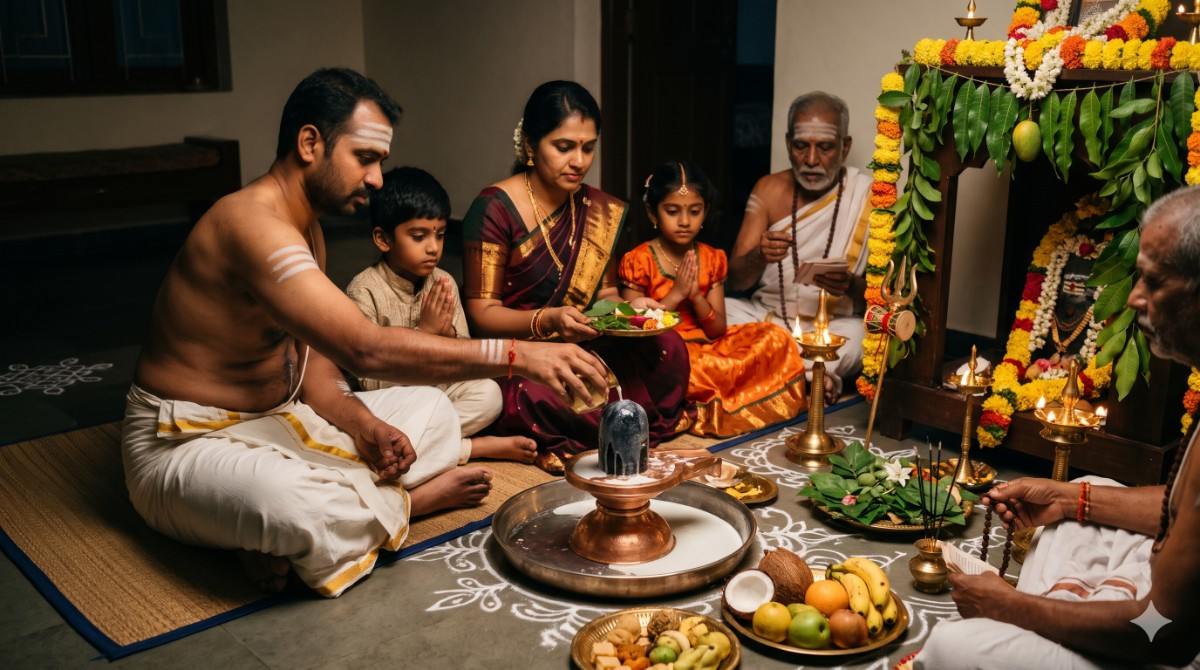
Celebrate the sacred night of Lord Shiva with a traditional Maha Shivaratri Pooja in Hyderabad arranged through 99Poojas. Whether you are planning Shiva Abhishekam, Rudrabhishekam or a night-long Maha Shivaratri celebration at home, choosing a suitable pandit helps your family perform the rituals according to its traditions.
99Poojas helps families in Hyderabad connect with pujaris for Hindu ceremonies. Share your location, preferred language, pooja requirements and schedule to discuss pandit availability, ritual arrangements and charges before confirming your booking.
Shiva Abhishekam
Rudrabhishekam
Four-Prahar Pooja
Nishita Kaal
🗓
6 March 2027
Night worship into 7 March
🌙
Nishita Kaal
12:03 AM–12:51 AM, 7 March
ॐ
Telugu pujaris
On request, subject to availability
₹
Request a quote
Confirm charges before booking
What is Maha Shivaratri Pooja?
Maha Shivaratri Pooja is the worship of Lord Shiva observed on Krishna Paksha Chaturdashi, particularly during the night. Devotees traditionally perform Shiva Abhishekam, offer bilva leaves, chant Shiva mantras and observe fasting or night vigil according to their customs. In Hyderabad, families can arrange a pandit-led ceremony at home, including a shorter abhishekam or four-prahar worship.
Key Takeaways
- Maha Shivaratri 2027: Saturday, 6 March 2027.
- Nishita Kaal in Hyderabad: 12:03 AM–12:51 AM on 7 March.
- Main rituals: Sankalpam, Shiva Abhishekam, Rudra chanting, bilva archana, naivedyam and aarti.
- Pooja options: A shorter home ceremony, Rudrabhishekam or four-prahar night worship.
- Booking: Enquire with 99Poojas about pandit availability, family traditions, samagri and total charges.
Book a Pandit
Book a Pandit for Maha Shivaratri Pooja in Hyderabad
Looking for a Maha Shivaratri Pujari in Hyderabad who can guide your family through the rituals?
99Poojas helps you enquire about pandits for home-based Shiva worship, with arrangements discussed according to your family's requirements. You can request a Telugu-speaking pujari, explain your preferred method of worship and confirm whether you need a regular Shivaratri pooja or a more elaborate Rudrabhishekam.
A pandit-led ceremony is particularly useful when family members want guidance with the sankalpam, Sanskrit mantras, abhishekam sequence and offerings.
Before arranging your pooja, share:
- Your name and Hyderabad locality.
- The number of family members participating.
- Your preferred language and family tradition.
- Whether you require Shiva Pooja, Rudrabhishekam or four-prahar worship.
- Whether you have a Shivalingam and pooja arrangements at home.
- Your preferred time and samagri requirements.
The exact rituals, duration, pandit assignment and charges should be agreed upon before booking.
Services Offered
Maha Shivaratri Pooja Services Offered by 99Poojas
Different families observe Maha Shivaratri in different ways. Some perform a single abhishekam with family prayers, while others arrange Rudra chanting and worship throughout the night.
The appropriate ceremony depends on your religious customs, available time and the guidance of your family priest.
⌂
Maha Shivaratri Pooja at Home
Maha Shivaratri Pooja at home allows families to worship Lord Shiva in a familiar environment without travelling to a crowded temple.
A typical home ceremony may include Ganapati prayer, sankalpam, Shiva Abhishekam, bilva archana, mantra chanting, naivedyam and aarti.
This arrangement can suit families with children or elderly members, or those who prefer to participate together at their own pooja mandapam.
If you live in an apartment, discuss water usage, overnight timings and available space before finalising the ceremony.
ॐ
Rudrabhishekam and Shiva Abhishekam
Rudrabhishekam is a form of Shiva worship in which the Shivalingam is ceremonially bathed while Vedic hymns, especially Sri Rudram, are recited according to the priest's tradition.
Shiva Abhishekam may involve water, milk, curd, honey and other permitted offerings, followed by bilva leaves, flowers and aarti.
The distinction is important: a simple Shiva Abhishekam does not necessarily include the complete Rudrabhishekam chanting procedure.
When booking, explain whether you want a basic abhishekam, Ekadasa Rudrabhishekam or another form of Rudra worship so the pandit can confirm the requirements.
4
Four Prahar Maha Shivaratri Pooja
Four Prahar Pooja, also called Char Prahar Pooja, divides Maha Shivaratri night into four worship periods.
A Shiva Abhishekam and accompanying prayers are performed during each period according to the family's sampradaya.
This is a more extensive observance than a single evening ceremony because it continues from sunset towards the following sunrise.
For families considering four-prahar worship, it is important to confirm whether the pandit will remain for all four periods, whether multiple abhishekams are included and how much preparation is required.
Cost
Maha Shivaratri Pooja Cost in Hyderabad
The cost of Maha Shivaratri Pooja in Hyderabad depends on the ritual selected, duration, pandit requirements, samagri and location.
A simple Shiva Abhishekam and a night-long four-prahar ceremony have different arrangements, so they should not be treated as identical packages.
99Poojas can discuss a quotation after understanding your requirements.
Maha Shivaratri Pooja packages
Package
What's included
Price
Silver
1 experienced priest. You arrange the pooja materials.
₹3,500
Gold (recommended)
2 experienced priests. All pooja materials (samagri) provided by 99Poojas.
₹5,000
Four-prahar Shivaratri pooja or with Rudra Homam
Night-long worship across four prahars, Rudrabhishekam, homam or more priests
Ask for a quote
How payment works
Package
Pay at booking (40%)
Pay after the pooja (60%)
Silver – ₹3,500
₹1,400
₹2,100
Gold – ₹5,000
₹2,000
₹3,000
Pay the 40% advance securely online when you book. The remaining 60% is paid after the pooja is completed. Cancellations made at least 48 hours before the pooja are refundable; cancellations within 48 hours are non-refundable.
Pooja Type
Typical Scope
Pricing
Shiva Pooja at Home
Sankalpam, abhishekam, archana and aarti
Request a quote
Rudrabhishekam
Shiva Abhishekam with Rudra chanting
Request a quote
Four Prahar Shivaratri Pooja
Four worship periods through the night
Request a quote
Additional Rudra Homam
Separate fire ritual, where suitable
Request a quote
What Is Included in the Pooja Package?
Before booking, ask for a clear breakdown covering:
- Pandit dakshina and travel arrangements.
- The selected pooja procedure and expected duration.
- Whether pooja samagri is supplied or arranged by your family.
- The number of pandits attending.
- Any additional costs for a night-long ceremony.
- Requirements for a Shivalingam, vessels and mandapam.
- Payment terms and rescheduling conditions.
Practical Tip: Compare the complete quoted amount rather than only the pandit's dakshina. Two packages may appear similarly priced but differ in samagri, chanting, number of rituals and time commitment.
2027 Date & Timings
Maha Shivaratri 2027 Date, Puja Timings and Nishita Kaal in Hyderabad
Maha Shivaratri will be observed on Saturday, 6 March 2027, in Hyderabad. The main worship takes place during the night of 6 March, continuing into the early hours of 7 March.
According to the Hyderabad-specific timings published by Drik Panchang, the important periods are:
Event
Hyderabad Date and Time (IST)
Maha Shivaratri
Saturday, 6 March 2027
Chaturdashi Tithi begins
6 March, 12:03 PM
Chaturdashi Tithi ends
7 March, 1:46 PM
First Prahar
6:24 PM–9:25 PM
Second Prahar
9:25 PM–12:27 AM
Third Prahar
12:27 AM–3:29 AM
Fourth Prahar
3:29 AM–6:30 AM
Nishita Kaal
7 March, 12:03 AM–12:51 AM
Shivaratri Parana
7 March, 6:30 AM–1:46 PM
Note: Prahar periods crossing midnight end on 7 March. Timings are specific to Hyderabad and may vary slightly between panchang calculation methods. Follow your family's priest or preferred panchang when finalising observances.
What Is Nishita Kaal?
Nishita Kaal is the midnight worship period traditionally regarded as particularly significant for Shiva worship on Maha Shivaratri.
Devotees who wish to perform Shiva Abhishekam during this period should arrange the ceremony and necessary materials beforehand. A family following four-prahar worship may also perform separate prayers during each prahar.
Pooja Vidhi
Maha Shivaratri Pooja Vidhi – Step-by-Step Procedure
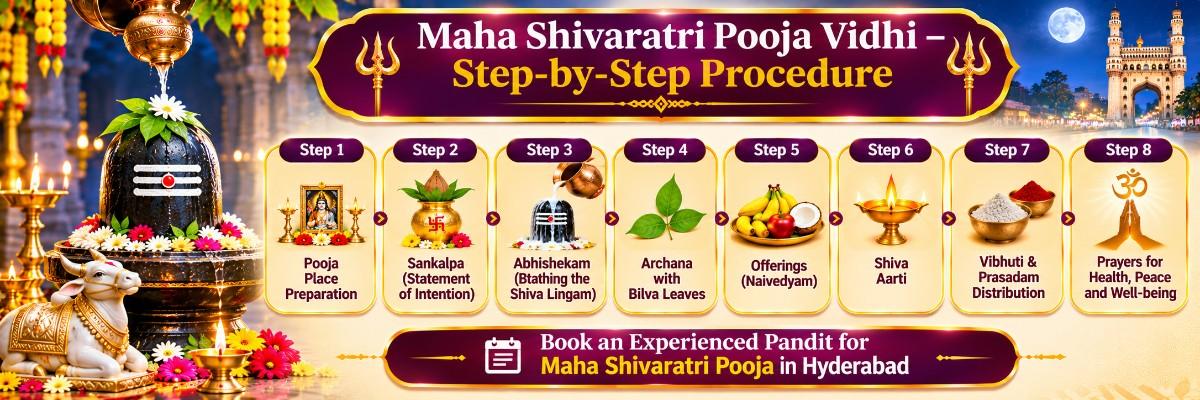
Maha Shivaratri Pooja Vidhi can differ between Telugu Smarta, Shaiva and other family traditions. The following is a general guide to help devotees understand the sequence.
1
Clean the pooja space
Prepare a clean and peaceful area for worship. Place the Shivalingam or approved form of Shiva worship on a suitable base that can collect abhishekam water.
2
Prepare for the ceremony
Family members bathe, wear clean clothes and arrange the required offerings. Those observing a vrat follow their customary fasting rules.
3
Ganapati Prarthana
The ceremony commonly begins with prayers to Lord Ganesha to seek an auspicious beginning.
4
Sankalpam
The pandit guides the devotees in stating their names, religious intention and details required by the ritual.
5
Shiva Abhishekam
The Shivalingam is ceremonially bathed using the prescribed offerings. The pandit determines the order of ingredients and recitation.
6
Rudra Mantra Chanting
Depending on the selected ceremony, Sri Rudram, Namakam, Chamakam, Panchakshari Mantra or other Shiva prayers may be recited.
7
Bilva Archana
Bilva leaves and suitable flowers are offered to Lord Shiva with devotion.
8
Naivedyam and Aarti
Food offerings are presented according to tradition, followed by deepa harathi and prayers for the family's well-being.
9
Prasadam and Completion
After the concluding prayers, family members receive prasadam. Devotees observing the fast follow the appropriate Parana time and custom.
The exact sequence should be confirmed with the officiating pandit.
Samagri List
Maha Shivaratri Pooja Samagri List
Preparing the samagri in advance helps the ceremony proceed smoothly and reduces last-minute confusion.
The following is a general Maha Shivaratri Pooja Samagri checklist.
Category
Commonly Used Items
Shiva worship
Shivalingam, suitable peetham or tray
Abhishekam
Clean water, milk, curd, honey, ghee and sugar, as prescribed
Sacred offerings
Bilva leaves, flowers, sandalwood paste and vibhuti
Pooja essentials
Akshata, turmeric, kumkum where appropriate, incense and camphor
Deepam
Lamp, oil or ghee, and cotton wicks
Naivedyam
Fruits, coconut and suitable sattvic prasadam
Vessels
Kalasham, abhishekam vessel, plates, bowls and spoons
Mandapam
Clean cloth, seating mat and deity decorations
Not every item is required for every form of worship. The prescribed list may differ by tradition.
What Should You Confirm With Your Pandit?
Ask whether the family must arrange the Shivalingam, bilva leaves and abhishekam vessels. Also confirm whether additional samagri is necessary for Rudrabhishekam or four-prahar worship.
Preparation Insight: Arrange a proper collection tray for abhishekam liquids. This is especially important in apartments, where excess liquid can spill onto electrical fittings, floors or neighbouring spaces. Dispose of offerings respectfully and in accordance with local sanitation requirements.
Preparing at Home
How to Prepare for Maha Shivaratri Pooja at Home
A well-prepared home helps family members participate comfortably, particularly when the ceremony continues late into the night.
- Choose a suitable pooja area. Select a clean and well-ventilated space with adequate room for the pandit and family members.
- Arrange a secure abhishekam setup. Place the Shivalingam on a stable surface with a suitable vessel or tray for collecting liquids.
- Keep samagri organised. Separate flowers, bilva leaves, liquids and other offerings into clearly identified containers.
- Prepare family seating. Provide clean mats or chairs where needed, especially for elderly participants.
- Plan safe lighting. Use a stable deepam and keep flames away from curtains, decorations and electrical wires.
- Discuss apartment arrangements. If you live in a gated community or apartment complex in Hyderabad, check whether overnight chanting, gatherings or other arrangements require permission.
- Plan for children and elderly members. Families performing night-long worship can arrange rest periods without expecting every member to remain awake throughout.
- Confirm the schedule. Keep the pandit's arrival time, ceremony duration and materials list accessible to everyone helping with preparations.
Fasting, Jagaran & Parana
Maha Shivaratri Fasting Rules, Jagaran and Parana
Maha Shivaratri is traditionally associated with upavasam (fasting), jagaran (night vigil) and Shiva worship.
These practices vary by family, religious tradition, health and personal capacity.
🍎
Maha Shivaratri Fasting Rules
Some devotees observe a strict fast, while others consume fruit, milk or permitted sattvic food according to their custom.
Fasting should not be treated as compulsory for every person. Children, pregnant women, older adults and people with medical conditions should avoid unsafe restrictions and seek appropriate professional advice when necessary.
🌙
What Is Shivaratri Jagaran?
Jagaran means remaining awake during the night in remembrance of Lord Shiva.
Devotees may spend this time chanting Om Namah Shivaya, listening to Shiva stotras, reading devotional texts, performing abhishekam or attending temple prayers.
Families unable to remain awake all night may participate in a shorter observance according to their traditions.
☀
When Should the Shivaratri Fast Be Broken?
Parana is the formal breaking of the vrat on the following day.
For Hyderabad in 2027, Drik Panchang lists the Parana period as 6:30 AM to 1:46 PM on Sunday, 7 March.
Some traditions observe specific differences in when the fast should end, so confirm the applicable practice with your priest.
Significance
Significance of Maha Shivaratri and Lord Shiva Worship
Maha Shivaratri means the Great Night of Shiva and is one of the important annual observances dedicated to Lord Shiva.
It is traditionally associated with devotion, spiritual discipline, contemplation and worship of Shiva as the divine principle of transformation.
Different religious narratives explain its significance. Some traditions connect the night with the manifestation of Shiva as an infinite column of light, called Lingodbhava. Others associate it with the divine union of Shiva and Parvati.
For Telugu families, Maha Shivaratri often includes temple visits, Lingodbhava Kala worship, Shiva Abhishekam, bilva offerings and night-long prayers.
Beyond the ceremonial aspects, the observance encourages devotees to set aside ordinary distractions and spend time in prayer, self-reflection and remembrance of Lord Shiva.
Spiritual Benefits
Spiritual Benefits of Performing Maha Shivaratri Pooja
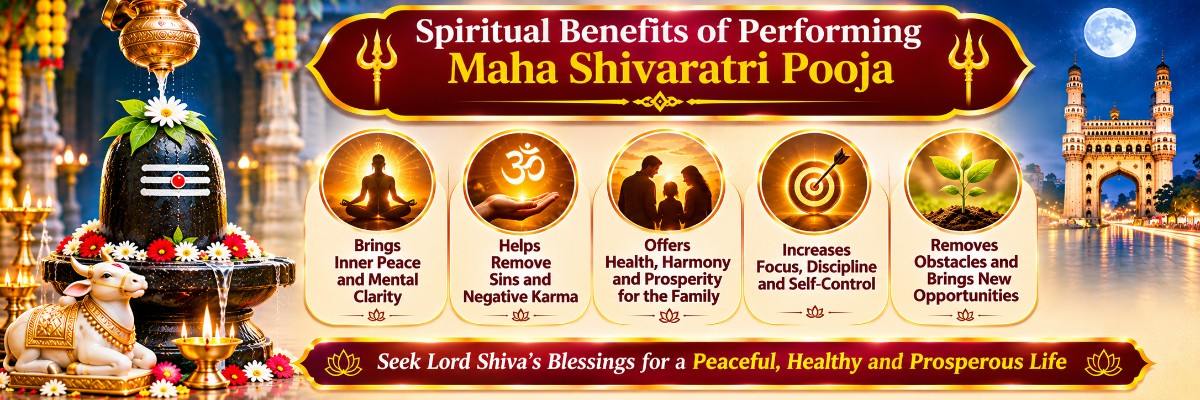
In Hindu devotional traditions, worshipping Lord Shiva during Maha Shivaratri is considered spiritually meaningful.
Devotees commonly associate the observance with:
- Seeking the blessings of Lord Shiva and Goddess Parvati.
- Cultivating inner peace and mental focus through prayer.
- Expressing gratitude and devotion.
- Practising self-discipline through vrat and jagaran.
- Strengthening family participation in religious traditions.
- Reflecting on forgiveness, compassion and spiritual growth.
These are spiritual beliefs and devotional aspirations, not promises of specific medical, financial or material outcomes.
Performing the ceremony with sincerity and understanding its meaning is more important than making elaborate arrangements beyond your family's needs.
Why 99Poojas
Why Choose 99Poojas for Maha Shivaratri Pooja in Hyderabad?
99Poojas is a Hyderabad-focused pooja service platform that helps families find pujaris and plan Hindu ceremonies.
When arranging Maha Shivaratri worship, the practical advantage of discussing your ceremony in advance is that you can match the ritual to your family tradition, available space and preferred schedule.
With 99Poojas, you can:
- Enquire about pandits for Maha Shivaratri and other Hindu rituals.
- Share preferences for Telugu or another available language.
- Discuss a shorter Shiva Pooja or more elaborate Rudrabhishekam.
- Clarify the samagri and home arrangements.
- Review pandit availability and the quoted charges before confirmation.
- Plan the ceremony for your Hyderabad locality.
Rather than choosing a ceremony based on its name alone, explain what your family wants to perform. This helps avoid confusion between a basic abhishekam, Rudrabhishekam and four-prahar worship.
Telugu Pujaris
Experienced Telugu Pujaris and Pandits for Maha Shivaratri
If you are looking for a Maha Shivaratri Pandit in Hyderabad, language and ritual familiarity are important considerations.
Many Telugu families prefer a pujari who can explain the sankalpam and guide participants in Telugu while reciting the prescribed Sanskrit mantras.
Other families may have different regional or sampradaya requirements.
When enquiring, share:
- Your preferred language.
- Whether the ceremony follows a specific family tradition.
- The form of Shiva worship you want.
- Whether you require extended Rudra chanting.
- Whether night-long availability is necessary.
Ask the 99Poojas team to confirm a suitable pandit's availability and experience with the requested ritual before finalising your ceremony.
Service Areas
Maha Shivaratri Pooja Services Across Hyderabad
99Poojas helps arrange pooja services across Hyderabad and Secunderabad, subject to pandit availability for the requested date, location and ceremony.
Families can enquire from localities including:
- Kukatpally and KPHB
- Miyapur and Nizampet
- Kondapur and Gachibowli
- Madhapur and HITEC City
- Manikonda and Narsingi
- Jubilee Hills and Banjara Hills
- Secunderabad
- Ameerpet and Begumpet
- Uppal and LB Nagar
- Dilsukhnagar and nearby residential areas
If your area is not listed, share your locality and pincode to check arrangements.
Maha Shivaratri night is a popular time for Shiva worship, so families seeking a specific midnight or four-prahar schedule should enquire in advance.
How to Book
How to Book Maha Shivaratri Pooja with 99Poojas
Booking your Maha Shivaratri pooja begins by sharing the basic details of your ceremony.
1
Select Maha Shivaratri Pooja
Visit 99Poojas and choose the Maha Shivaratri service or booking enquiry option.
2
Share Your Requirements
Provide your name, phone number, Hyderabad address, preferred language and selected pooja.
3
Discuss the Ritual and Timings
Explain whether you need a home Shiva Pooja, Rudrabhishekam or four-prahar ceremony. Mention any specific muhurtham or family practice.
4
Review the Quotation
Confirm pandit charges, samagri, duration, travel requirements and other applicable arrangements.
5
Confirm the Booking
Proceed once the arrangements and availability have been confirmed by the team.
For booking assistance, contact 99Poojas at:
Phone: +91 88850 43059 / +91 88850 43069
Website: https://99poojas.com/
Call +91 88850 43059Confirm Before Booking
Important Details to Confirm Before Booking
Before confirming your Maha Shivaratri Pandit booking, use this checklist to avoid misunderstandings.
- Is the ceremony a single Shiva Abhishekam, Rudrabhishekam or full four-prahar pooja?
- What is the agreed arrival time and expected completion time?
- Will the selected pandit perform the complete requested chanting?
- Is the Shivalingam available at the venue?
- Who will arrange bilva leaves and the required abhishekam items?
- Is dakshina included in the total quotation?
- Are travel and late-night requirements included?
- Can the ceremony be conducted comfortably in the available home space?
- What happens if the booking time needs to be changed?
For a midnight ceremony, check that the scheduled abhishekam actually fits the relevant muhurtham. A booking labelled “Maha Shivaratri Pooja” does not automatically mean the pandit is reserved for Nishita Kaal or all four prahars.
FAQs
Frequently Asked Questions About Maha Shivaratri Pooja in Hyderabad
1. When is Maha Shivaratri in Hyderabad in 2027?
Maha Shivaratri falls on Saturday, 6 March 2027. The main night-time worship continues into Sunday, 7 March.
2. What is the Nishita Kaal time for Maha Shivaratri 2027?
For Hyderabad, Nishita Kaal is from 12:03 AM to 12:51 AM on 7 March 2027, according to Drik Panchang.
3. How much does Maha Shivaratri Pooja cost in Hyderabad?
Maha Shivaratri Pooja in Hyderabad costs ₹3,500 with the Silver package (one priest; your family arranges the samagri) or ₹5,000 with the Gold package (two priests, with all samagri provided by 99Poojas). You pay a 40% advance when booking and the remaining 60% after the pooja.
The price depends on the ceremony, pandit requirements, duration, samagri and location. Contact 99Poojas for a quotation based on the ritual you want to perform.
4. Can I book a pandit for Maha Shivaratri Pooja at home?
Yes. You can enquire with 99Poojas about a pandit for home-based Maha Shivaratri worship in Hyderabad. Availability and arrangements should be confirmed before booking.
5. Can I request a Telugu-speaking Maha Shivaratri pujari?
Yes. Telugu can be specified as your preferred language during the enquiry. The team can check the availability of a suitable pujari for your ceremony.
6. What is the difference between Shiva Pooja and Rudrabhishekam?
Shiva Pooja is a broader form of worship that may include prayers, offerings and abhishekam. Rudrabhishekam specifically involves abhishekam accompanied by Vedic Rudra chanting according to the selected tradition.
7. How long does Maha Shivaratri Pooja take?
A shorter home pooja may take approximately one to three hours, depending on its components. Four-prahar worship extends across the night. The exact duration should be confirmed with the pandit.
8. What items are needed for Maha Shivaratri Pooja?
Common items include a Shivalingam, clean water, bilva leaves, flowers, abhishekam ingredients, a lamp, incense, fruits and pooja vessels. Your pandit will confirm the exact list.
9. Is fasting compulsory on Maha Shivaratri?
Fasting is an important tradition for many devotees, but its form varies. People should observe religious practices according to their health, capacity and family customs.
10. Can Maha Shivaratri Pooja be performed without a temple visit?
Yes. Lord Shiva can be worshipped at home through prayers, chanting, abhishekam and other appropriate rituals. Temple visits are devotional choices rather than a universal requirement for home worship.
11. What is Four Prahar Pooja?
Four Prahar Pooja divides Maha Shivaratri night into four periods of worship. Devotees perform Shiva prayers and abhishekam during each period according to their tradition.
12. Can I arrange Shivaratri Pooja in a Hyderabad apartment?
Yes, provided there is a suitable pooja area and the ceremony complies with apartment rules. For night-long worship, discuss noise, water collection and any community restrictions in advance.
13. Is pooja samagri included in the booking?
Yes, pooja samagri is included in the Gold package priced at ₹5,000. For the Silver package priced at ₹3,500, the family must arrange the required pooja materials. Samagri requirements for extended four-prahar worship or additional rituals will be confirmed separately.
14. Can I book only Rudrabhishekam for Maha Shivaratri?
You can enquire about Rudrabhishekam as a separate ceremony. Confirm the chanting procedure, duration, samagri and availability.
15. How early should I book a Maha Shivaratri Pandit?
It is sensible to enquire several weeks ahead when possible, particularly for Nishita Kaal and four-prahar worship. Booking availability depends on the date and locality.
16. What time should I break my Maha Shivaratri fast in 2027?
For Hyderabad, the listed Parana period is 6:30 AM to 1:46 PM on Sunday, 7 March 2027. Follow your family's customary fasting rules and priest's guidance.
Related Services
Related Lord Shiva Pooja Services in Hyderabad
Families interested in Maha Shivaratri worship may also wish to explore other ceremonies dedicated to Lord Shiva.
ॐ
Rudrabhishekam in Hyderabad
A traditional Shiva Abhishekam with Rudra chanting, performed on Maha Shivaratri and other suitable occasions.
🔥
Rudra Homam in Hyderabad
A separate Vedic fire ritual associated with the worship of Lord Rudra. It requires its own preparations and should not be confused with a basic Shiva Abhishekam.
🔥
Mrityunjaya Homam in Hyderabad
A Hindu fire ritual centred on the Maha Mrityunjaya Mantra and prayers traditionally associated with Lord Shiva.
🧵
Kedareshwara Vratham in Hyderabad
A devotional vrata associated with Lord Shiva, observed according to family traditions and the prescribed religious calendar.
Explore the relevant service pages on 99Poojas for information about each ceremony.
Book & Enquiry Form
Book Maha Shivaratri Pooja in Hyderabad with 99Poojas
Maha Shivaratri is an occasion for families to come together in devotion to Lord Shiva through abhishekam, prayers, mantra chanting and spiritual reflection.
Whether you are organising a simple Shiva Pooja at home or a more elaborate Rudrabhishekam, the right arrangements can help your family focus on the meaning of the celebration.
Contact 99Poojas to discuss Maha Shivaratri Pooja in Hyderabad, check pandit availability and receive information about the ceremony and charges.
Call: +91 88850 43059 / +91 88850 43069
Book Online: https://99poojas.com/shop/
Call +91 88850 4305999Poojas – Helping Hyderabad families plan traditional Hindu poojas with care and clarity. You may also explore Rudra Homam, Mrityunjaya Homam and Kedareshwara Vratham.